Looking for quality packable travel gear at great prices?
Outdoor Travels shops at these  suppliers.
If we don't use a supplier, we don't endorse them.
Spain Fast Facts:
Area: 504,750 sq km; 194,884 sq miles
Population: 39.5 million (growth rate 0.2%)
Languages: Castilian Spanish (official language), Catalonian, Galician, Valenciano, Vasco (are also official languages in the autonomous communities of Catalonia, Galicia, Valencia and Basque Country, respectively)
Religion: 99% Roman Catholic
Capital: Madrid
Form of Government: Constitutional Monarchy
Currency: Euro
Visas: No visa required for EU passport holders and for U.S. and Canadian citizens staying up to 90 days.
Electricity: 220V
Weights and Measures: metric
                                                                                                                                  

Spain Overview
Spain is located at the Iberian Península, of which it occupies approximately 80% (the remaining 20% are occupied by Portugal), in the southwest of Europe. In the north Spain borders on France and Andorra, with the Pyrenees as a natural frontier. Additionally the Balearic Islands (Mallorca, Menorca and Ibiza) in the Mediterranean Sea, Canary Islands in Atlantic Ocean close to the Moroccian coast, and Ceuta and Melilla, located in northern Africa, are Spanish territory.

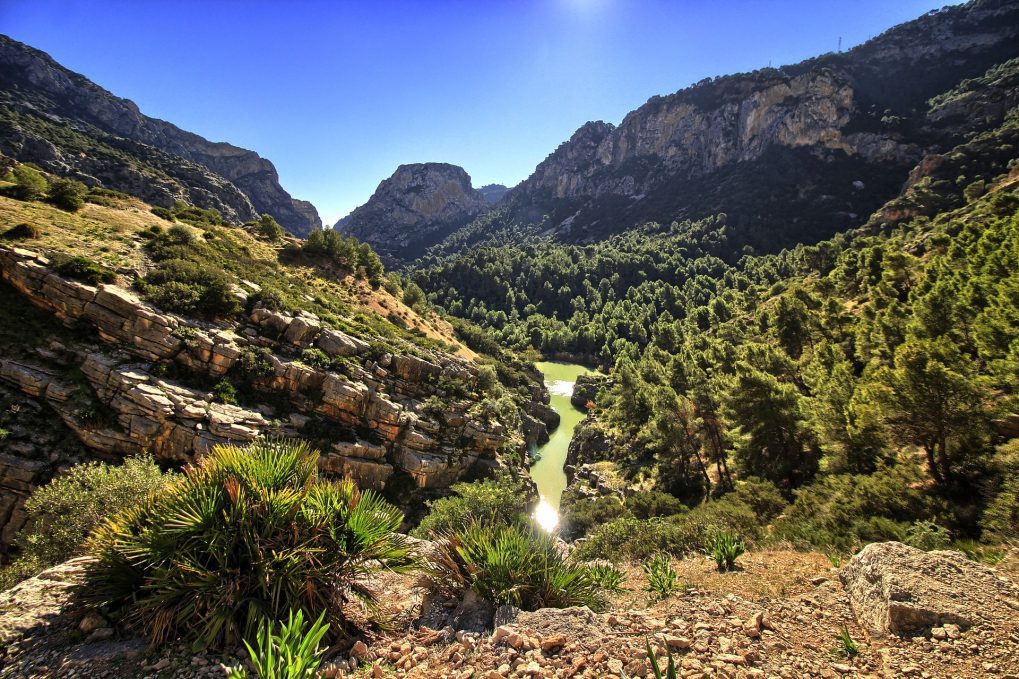
There are five big mountain ranges crossing the country, and about 50% of it are located at an elevated plain. Landscapes are extremely varied, some almost desert-like, others green and fertile, and of course there are the long coasts, in the east along Mediterranean Sea from Pyrenees to Gibraltar, and in the west (the major part of the Iberian peninsula's western coast is occupied by Portugal) along the Atlantic Ocean and Cantabrian Sea.

Andalucia
Andalucia is a mountainous region in the far south of Spain, rich in minerals and an important centre for the production of olives, grapes, oranges and lemons. Andalucia (Al-Andalus) was the last stronghold of the Moors who first arrived here from North Africa early in the eighth century and were finally expelled in 1492. The Arab architectural legacy is an important reason for visiting the region, especially the three great cities of Granada, Córdoba and Seville.

Andalucia is the Spanish Autonomous Community with the greatest number of inhabitants and the second in surface. Its varied landscapes, the benignancy of its climate and the friendly character of its population have turned it into one of the most attractive regions.

3000 hours of sun per year, many kilometers of golden sand beaches and those beautiful natural ports made it a safe refuge already for Phoenician navigators, thousands of years before Christ.

The coast of Huelva and Cadiz corresponds to the Atlantic Ocean and is characterized by fine sand. The Mediterranean coast, from the Strait of Gibraltar to Almeria, on the other hand offers smoother climate with less wind and higher water temperatures.

Andalusia is crossed by Guadalquivir river, the "father" of old civilisations who have left along its borders an impressive monumental track, as well as the high mountain ranges of Sierra Morena and Sistemas Beticos.

The offer for visitors is extremely varied, from golden beaches to those beautiful mountain ranges with their highly interesting fauna, and the famous "white villages" with their richdom in folklore and artisany. There are great possibilities for most different sports as well, from skiing in the Sierra Nevada to surfing at the coast of Cadiz, where you will find ideal conditions as nowhere else in Europe.

Andalusia is the "mother" of the Spanish folklore which is probably best known abroad: here you will live the magic of Flamenco and bullfighting in their most authentic style, and myths like Don Juan and Carmen were born here. A land of great traditions, which has understood as well to assimilate the progress.


Areas we visited:
Cazorla - A picturesque pueblos blanco (white village) situated below the Pena de los Halcones, the village's narrow and steep rising streets from an environment of beautiful architecture create a sight to behold. Two castles of Muslim origin sit perched above the city. The town is home to approximately 10,000 residents. Cazorla is a natural gateway to Cazorla Natural Park which is one of Europes finest, and Spain's largests Natural Parks.

In Cazorla, beer, cured ham and tapas (small plates of food) are not only predominant here, they are omnipresent; expect to enjoy the local cuisine in the form of an ever changing variety of tapas washed down with a little beer. The people of Cazorla are friendly and helpful. You'll just need to get passed their initial dour expressions to find a smiling, friendly and helpful person. Not much English is spoken here so it is a good idea to brush up on your conversational Spanish before visiting.

Granada - The Moorish Jewel, located at the foots of snowy Sierra Nevada mountain range, is a must-see. Most outstanding is certainly the great Arabian palace Alhambra. Granada is one of the pearls of Spain, most visited by tourists from all the world. The long-time capital of Moorish Andalusia has to offer the most important reminds of this epoch in Spanish history, with the world-famous "Alhambra" at the top of the list.

Walk through beautiful gardens, charming narrow streets filled with flowers, sit down in one of those typical taverns to have some of that famous "Trevélez" ham and local wine, and breath the centuries of history around you anywhere. There are gypsies singing "Flamenco", and don't miss to visit their famous "Cuevas" - caves - in the mountain of the monastery of Sacromonte where some of them really live still nowadays making magnificent artisany. Granada's popular festivals, based as well on Moorish as Christian tradition, are most attractive. The city is located at the foot of the "Sierre Nevada", Spain's highest mountain-massif with great posssibilities for winter-sports. The highest peak, "Mulhacén" arrives to 3478 meters. On the other hand it is not far from the Mediterranean sea, so Granada is a great place to visit in any season.

Cordoba - The long-time center of Moorish Spain preserves monuments of outstanding importance. The Mezquita, the great Mosque, is perhaps most impressive. As impressive and surprising Cordoba presents itself to today's visitor, as impressive and surprising was its past. Not many know that in 11th century it was one of the most important capitals in Europe. People of the most different cultures and religions - Jews, Muslims and Christians - were living peacefully together, and important philosophers, scientists and artists emerged from here. Knowing about Cordoba's cultural background you will certainly find interesting additional aspects when visiting its great monuments - first of all of course the world-famous Mezquita, the Moorish mosque - and museums. On the other hand Cordoba is as well a very lively town in the best Andalusian tradition, a town of Flamenco and bullfighting, and certainly one of the most attractive destinations in southern Spain
Top5Deals
Travel 125x125
Links:
Cazorla City Map
Cordova City Map
Useful Links
How was our trip?

  Travel Diary

Experience being there!

  Travel Photos


  Video from Train


  Video from Cordoba
Area Overview: Spain, Anadalucia -
Madrid, Cazorla, Grenada & Cordoba